"Exploring Coherent Structures Using Dual-Doppler Lidar Systems" (EDDy)
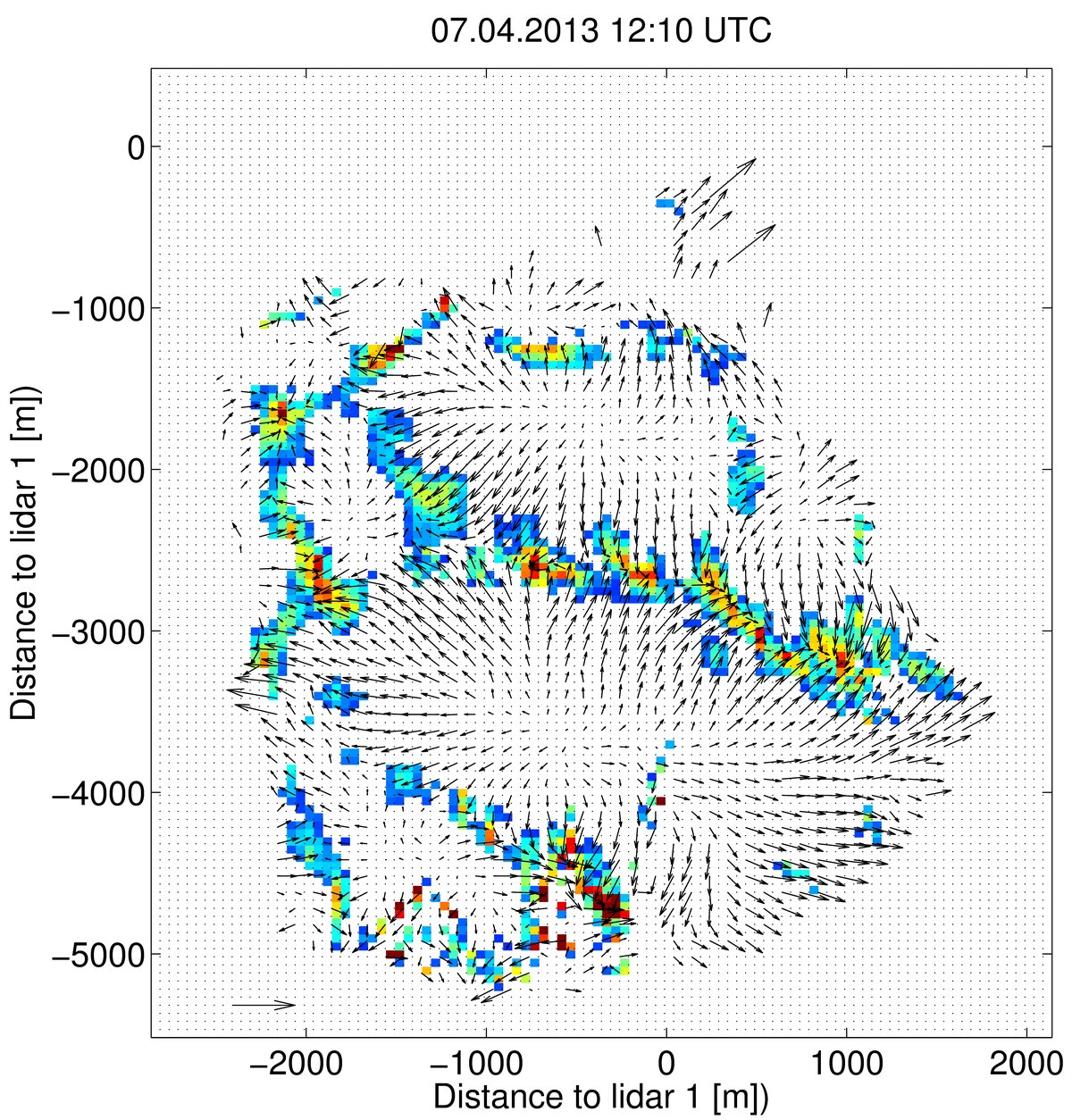
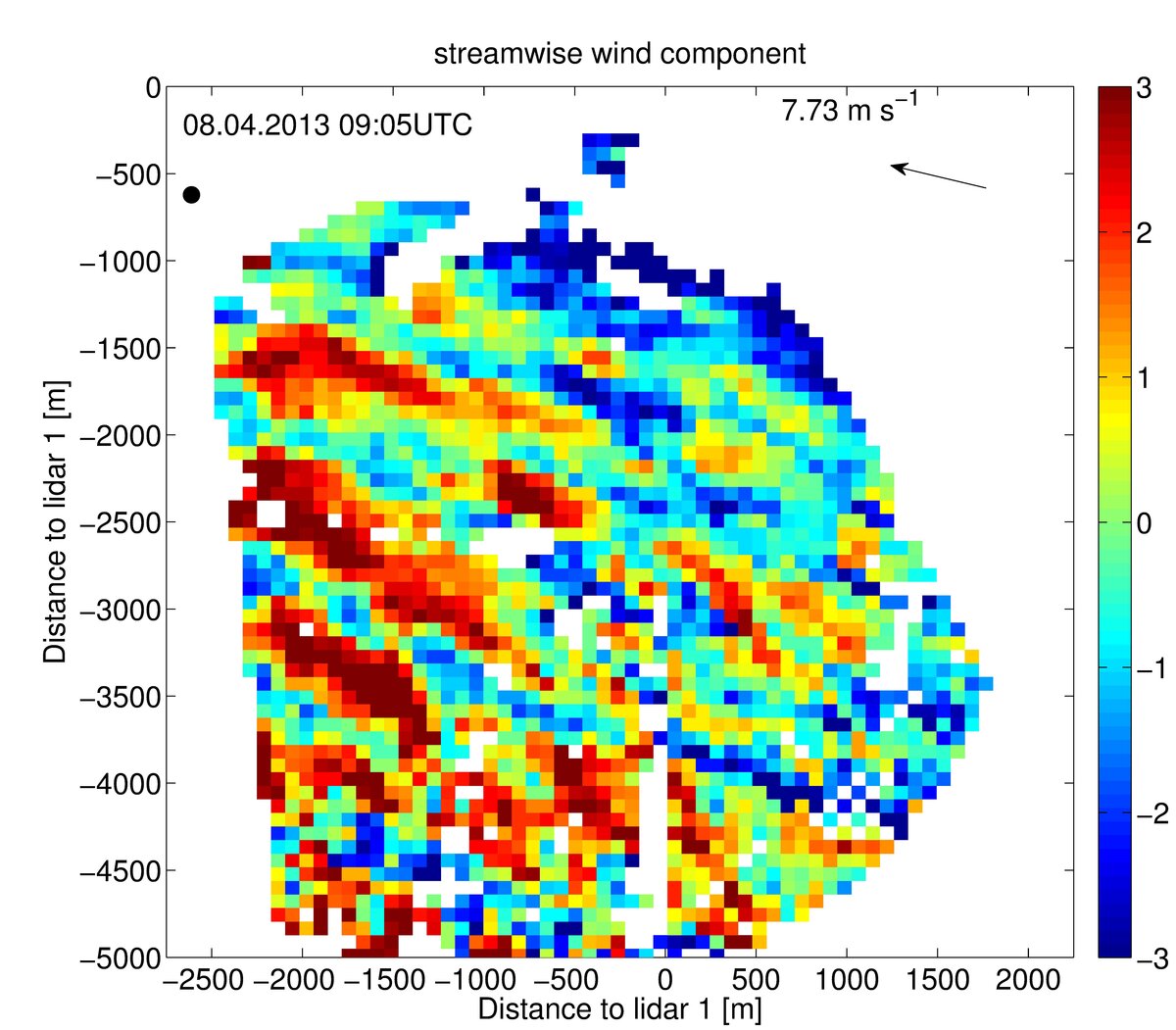
The atmospheric boundary layer is the lowest part of the troposphere. It extends from the ground up to a height of about 1 to 2 km thus being the part of the atmosphere where we live. The wind in the boundary layer is characterized by turbulence, i.e. random, unpredictable motions. In this chaotic wind field, however, distinct patterns, so-called coherent structures, may occur (Fig. 1).
![]() |
| Fig. 1 Honeycomb-shaped patterns in the velocity field of a large-eddy simulation (left, PALM model, S. Raasch) and elongated areas aligned in wind direction, so-called streaks, (right, lidar measurements) are examples of coherent structures. |
Although the occurrence of coherent structures in turbulent fluids has been explored since the 1930s, we know little about their characteristics, their occurrence, and their influence within the atmospheric boundary layer. This is due to the lack of methods for detecting this multi-dimensional phenomenon.
Innovative Dual-Doppler lidar methods can now be used to capture coherent structures and investigate them. On the one hand, process studies can be conducted in that way, for example to give information on the initiation of convection or on the cause of damage at roughness steps such as forest edges under high-wind conditions. On the other hand, it is possible to identify the influence of these structures on material and energy flows within the boundary layer and to improve their representation in atmospheric models.
EDDy focuses on the following questions:
- Which coherent motions can be observed in the atmospheric boundary layer? What forms do exist? What dependencies arise in connection with the stability of the atmospheric stratification and the vegetation height?
- What mechanisms cause the formation of coherent motions?
- How do these structures influence the turbulent transport processes in the boundary layer?