
How the 2022 Hunga Eruption Changed Earth’s Atmosphere
On 15 January 2022, the Hunga volcano erupted resulting in the most powerful underwater explosions ever recorded, offering scientists a rare opportunity to directly observe how the atmosphere responds to a major natural perturbation. Originating from a shallow submarine vent, this eruption differed fundamentally from recent large subaerial eruptions such as El Chichón (1982) and Mount Pinatubo (1991). The interaction with seawater amplified explosivity while strongly limiting sulfur dioxide emissions, creating an atmospheric impact unlike any previously observed.
Scientists from IMKTRO, including Julia Bruckert, Simran Chopra and Ali Hoshyaripour, contributed to a major international assessment report [1] coordinated under the auspices of the World Climate Research Programme (WCRP) and Atmosphere Processes And their Role in Climate (APARC). The assessment brought together 159 scientists from 21 countries and was released on 18 December 2025 at the American Geophysical Union annual meeting. It provides the most comprehensive evaluation to date of how the Hunga eruption altered the atmosphere, from stratospheric hydration and aerosol formation to ozone chemistry and radiative impacts.
The eruption produced a towering volcanic plume, with overshooting tops reaching up to 58 km altitude in the lower mesosphere. While the stratospheric sulfur injection was modest (only ~0.5–1.0 Tg of SO₂ reached the stratosphere) the eruption injected an exceptional amount of water vapour, increasing the global stratospheric water vapour burden by approximately 10% (~150 Tg). Much of this excess water remains detectable in the atmosphere through 2025, making the event unprecedented in the satellite record in terms of magnitude, altitude, and persistence.
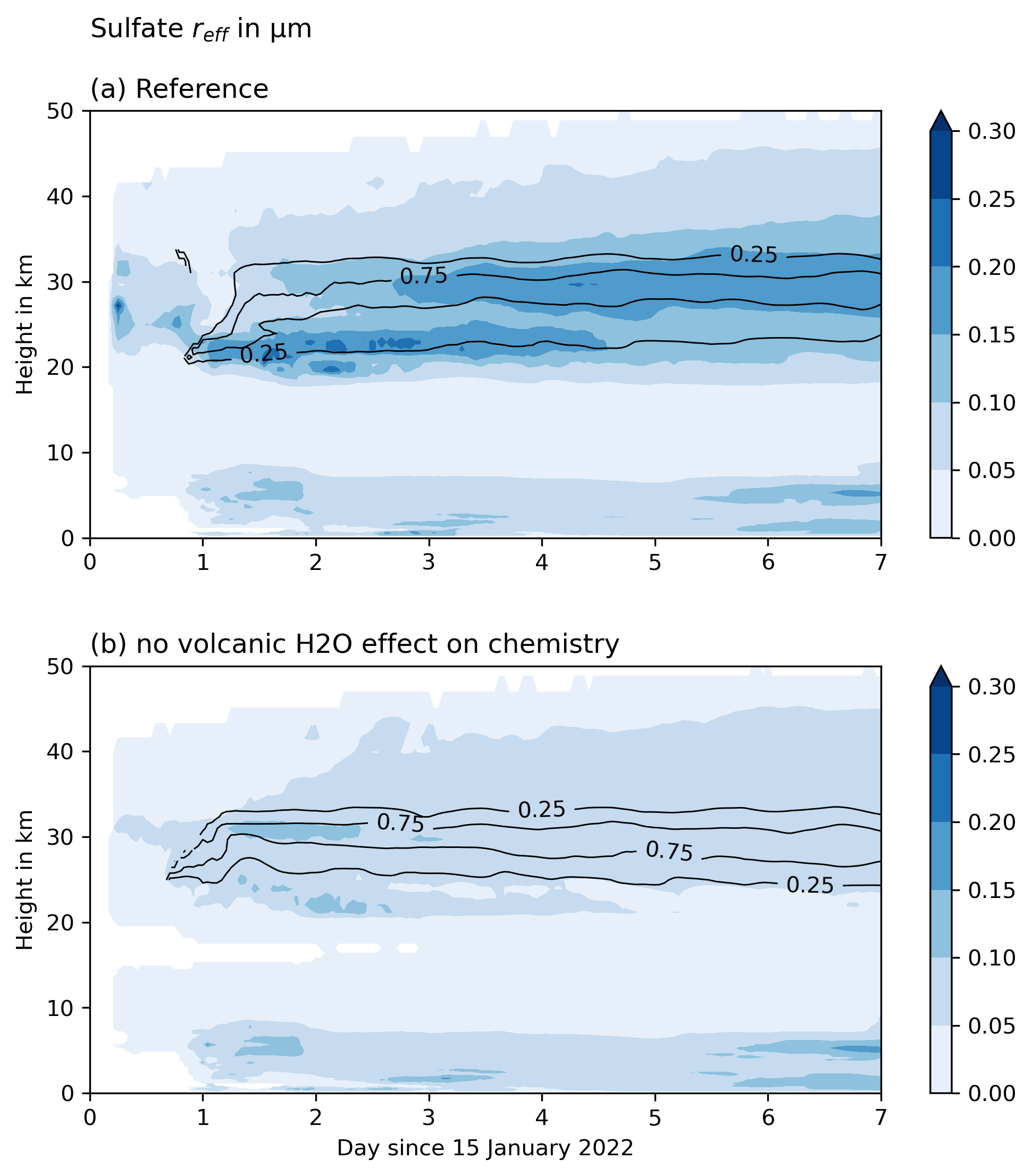
A key contribution from IMKTRO scientists was the detailed analysis of aerosol formation and microphysical evolution. The unusually high water vapour concentrations led to abundant hydroxyl radicals (OH), causing an exceptionally rapid conversion of SO₂ into sulfate aerosol [2]. Instead of taking weeks, as is typical in the stratosphere, sulfate formation occurred within days, and appeared largely complete within three weeks. Satellite observations show that, after the first two days, the plume consisted predominantly of spherical, non-absorbing sulfate particles, consistent with independent estimates of aerosol mass from remote sensing and in situ measurements.
This rapid chemical conversion triggered fast aerosol nucleation and growth. The early observations of aerosol microphysical properties revealed rapid particle growth to radii of approximately 0.4 μm within only a few weeks; a process that took several months following the 1991 Mount Pinatubo eruption. Using ICON-ART modeling system, IMKTRO researchers were successfully able to simulate and explain these observations to a large extent. These relatively large particles efficiently scattered solar radiation and were responsible for the high aerosol optical depth observed in the volcanic cloud.
Beyond aerosols, the assessment documents widespread but mostly temporary impacts on atmospheric composition, including ozone. A rapid ozone decline of about 5% was observed in parts of the tropical lower stratosphere shortly after the eruption, driven by enhanced water vapour and heterogeneous chemistry on sulfate aerosols. However, the eruption did not substantially affect the Antarctic or Arctic ozone holes, and its net influence on surface climate was small, with global temperature impacts well below natural variability.
This unprecedented assessment allowed us to quantify how an extreme submarine eruption changes the atmosphere, from stratospheric hydration and aerosols to ozone chemistry. The findings provide critical insights into the short- and long-term impacts of major volcanic eruptions on the Earth system and underscore the importance of monitoring extreme geophysical events.
[1] APARC, 2025: The Hunga Volcanic Eruption Atmospheric Impacts Report. Yunqian Zhu, Graham Mann, Paul A. Newman, and William Randel (Eds.), APARC Report No. 11, WCRP-10/2025, doi: 10.34734/FZJ-2025-05237, available at www.aparc-climate.org/publications/
[2] Bruckert, J., Chopra, S., Siddans, R., Wedler, C., and Hoshyaripour, G. A.: Aerosol dynamic processes in the Hunga plume in January 2022: does water vapor accelerate aerosol aging?, Atmos. Chem. Phys., 25, 9859–9884, https://doi.org/10.5194/acp-25-9859-2025, 2025.