
Wind measurements are the key to tropical weather prediction
Weather forecasting in the tropics remains one of the big challenges of modern meteorology. On one hand, weather prediction models struggle to represent the complex interactions of the frequent thunderstorms with larger-scale weather systems. On the other hand, the observational system is much less dense than, for example, in the northern hemisphere midlatitudes, due to the large fraction of ocean and a scarce station network on land. A further complicating factor is that in the tropics one needs to measure both wind and temperature for an accurate description of the atmospheric state, while in the midlatitudes one can to a great extent be inferred from the other.
Recent work at IMKTRO, including partners from the Universities of Munich and Vienna, have underlined the outstanding importance of wind information for the Tropics. Ruckstuhl et al. (2026) use a simplified tropical aquachannel (restriction to 30°S–30°N, no land, no east-west variation in sea-surface temperature) to investigate the influence of different meteorological parameters on rainfall prediction. It is shown that if accurate wind information can be provided to the forecast model, skillful predictions out to about two weeks are possible without any additional information on temperature, humidity and pressure.
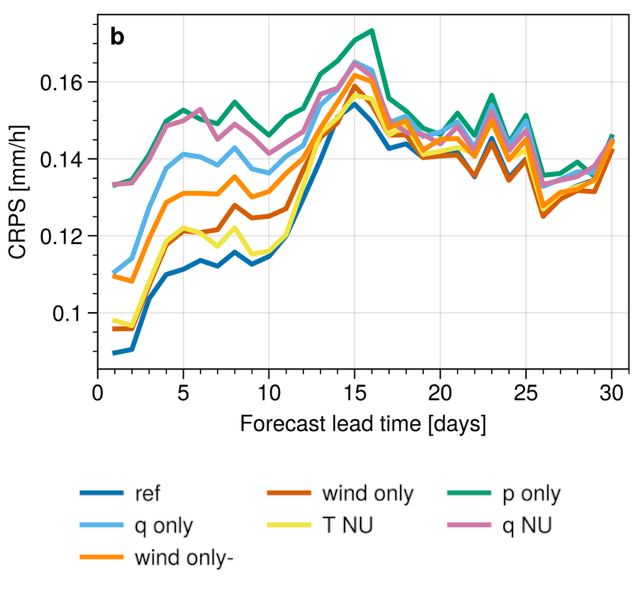
The idealized results by Ruckstuhl et al. (2026) are consistent with recent work based on the full blown operational weather prediction system of the European Centre for Medium-Range Weather Forecasts (ECMWF) by Borne et al. (2023, 2025). They demonstrate that data from the Aeolus satellite, the first ever wind lidar in space, have a disproportional positive impact on wind and precipitation forecasts around the world. While the impact on wind is at best surprising in its magnitude, the precipitation impact is more indirect and most evident in the wintertime extratropics, where the wind information appears to help better forecast cyclones and their fronts.
“Given these encouraging results, it is good to know that the European Space Agency (ESA) has decided to start a second Aeolus mission in the early 2030s. “, says Prof. Dr. Peter Knippertz, who was involved in all three studies.
References
Borne, M., Knippertz, P., Weissmann, M., Martin, A., Rennie, M., Cress, A., 2023: Impact of Aeolus wind lidar observations on the representation of the West African monsoon circulation in the ECMWF and DWD forecasting systems. Quart. J. Roy. Meteorol. Soc., 149(752), 933-958, https://doi.org/10.1002/qj.4442.
Borne, M., Knippertz, P., Rennie, M., and Weissmann, M., 2025: The impact of Aeolus observations on wind and rainfall predictions, EGUsphere [preprint], https://doi.org/10.5194/egusphere-2025-5219.
Ruckstuhl, Y., T. Janjić, H. Jung, P. Knippertz, and R. Redl, 2026: On the role of data assimilation in the prediction of tropical rainfall. Mon. Wea. Rev., e240129, https://doi.org/10.1175/MWR-D-24-0129.1, in press.