
Machine learning model for the prediction of potential hail tracks in Germany
Hail is among the most destructive hazards associated with severe convective storms. For instance, the severe hailstorms that occurred in Germany on 27-28 July 2013 resulted in damage amounting to several billions of euros (Kunz et al., 2018). However, direct observational hail records are limited. The analysis of changes in hail frequency in Germany in this study is thus based on severe convective cell tracks identified over 20 years from 3D radar data of the German Weather Service (DWD). The resulting potential hail tracks (PHTs) were recently statistically evaluated by Mohr et al. (2026) to quantify spatial patterns, temporal variability, and possible trends in hail activity in Germany, and validated by comparison with building insurance data.
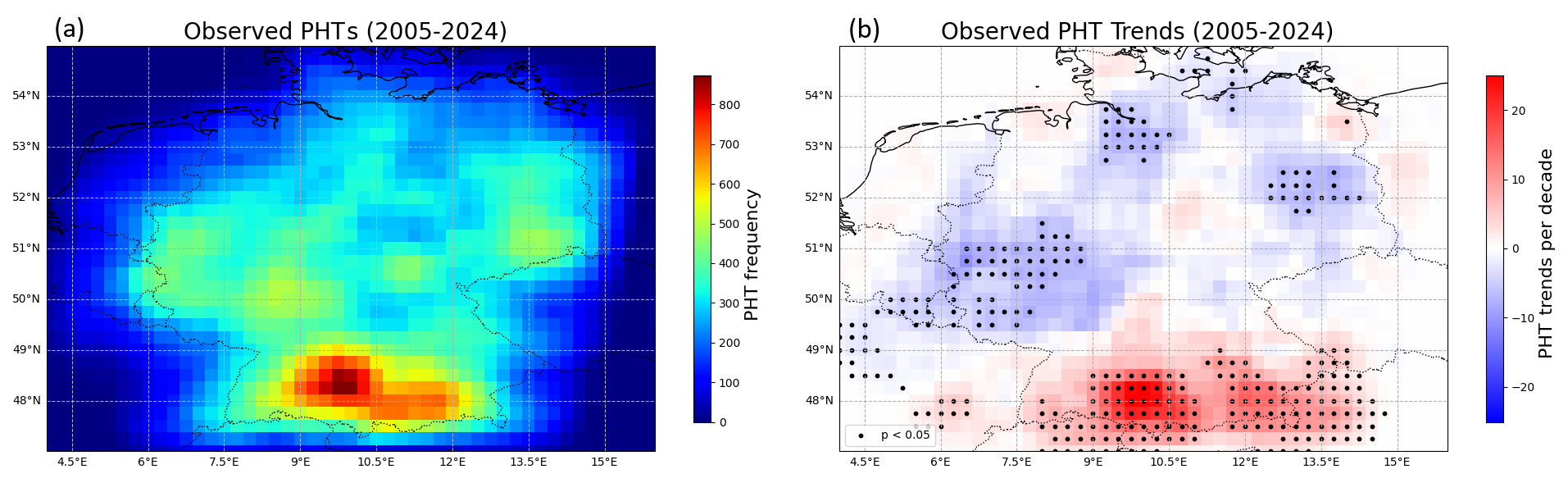
In order to establish a link between hail occurrence and its environmental drivers, convolutional neural networks, specifically U-Net architectures, are trained with 13 convection-relevant parameters from a reanalysis dataset to predict these PHTs. The convection-relevant parameters were derived from ERA5 (Hersbach et al., 2020) using the ThundeR package (Czernecki et al., 2025). To account for the advection speed of PHTs, not only the ERA5 grid point closest to a PHT per hour is selected, but also the eight grid points surrounding it. This effectively implements a spatial smoothing process, and the resulting overall spatial distribution and the associated trends are shown in Figure 1. The total spatial number of PHTs (Fig. 1a) exhibits distinct regional patterns, including a north-to-south gradient influenced by the proximity to seas and orographic features. A trend analysis of the radar-based tracks (Fig. 1b) reveals a variable spatial pattern: while a significant increase in hail activity has been observed in southern Germany, no or slightly negative trends have been identified in northern Germany.
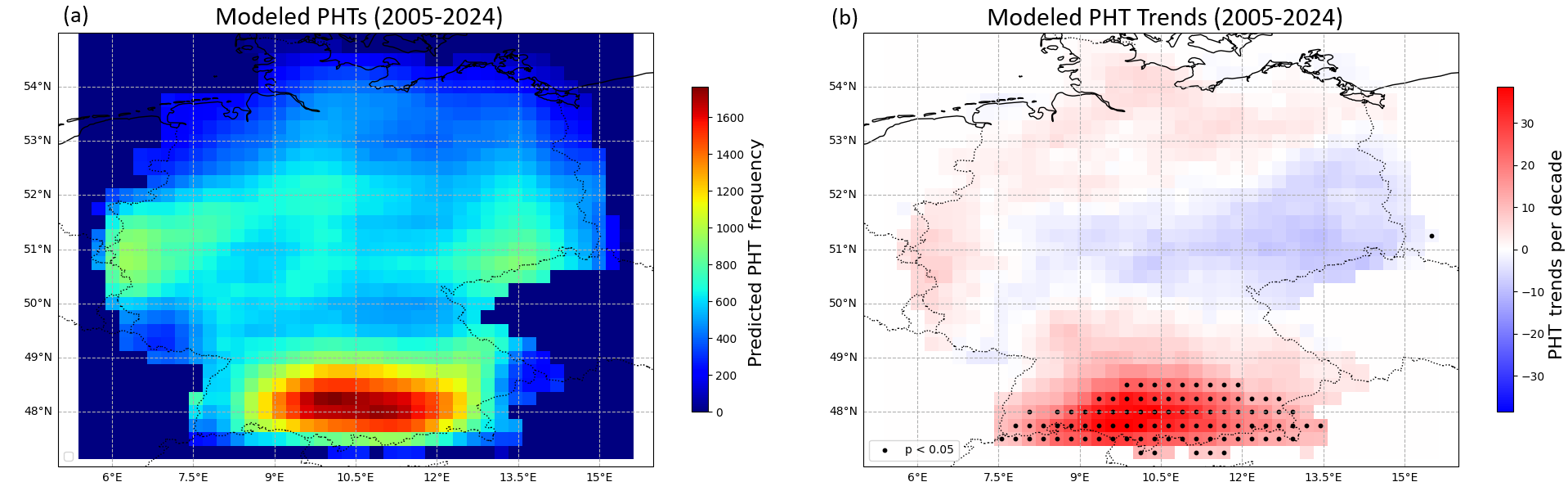
The employed machine learning (ML) models demonstrate a high degree of success in replicating the distinct spatial patterns of the climatology (Fig. 2a). Additionally, they can correctly reproduce the region of significant positive trends in southern Germany (Fig. 2b). This finding suggests that the observed trend in southern Germany is likely driven by changes in large-scale convective environments as depicted by the models. However, the small but significant negative trends in northern Germany are not replicated by the model used. This suggests that the model may still be missing relevant parameters, which is currently being investigated.
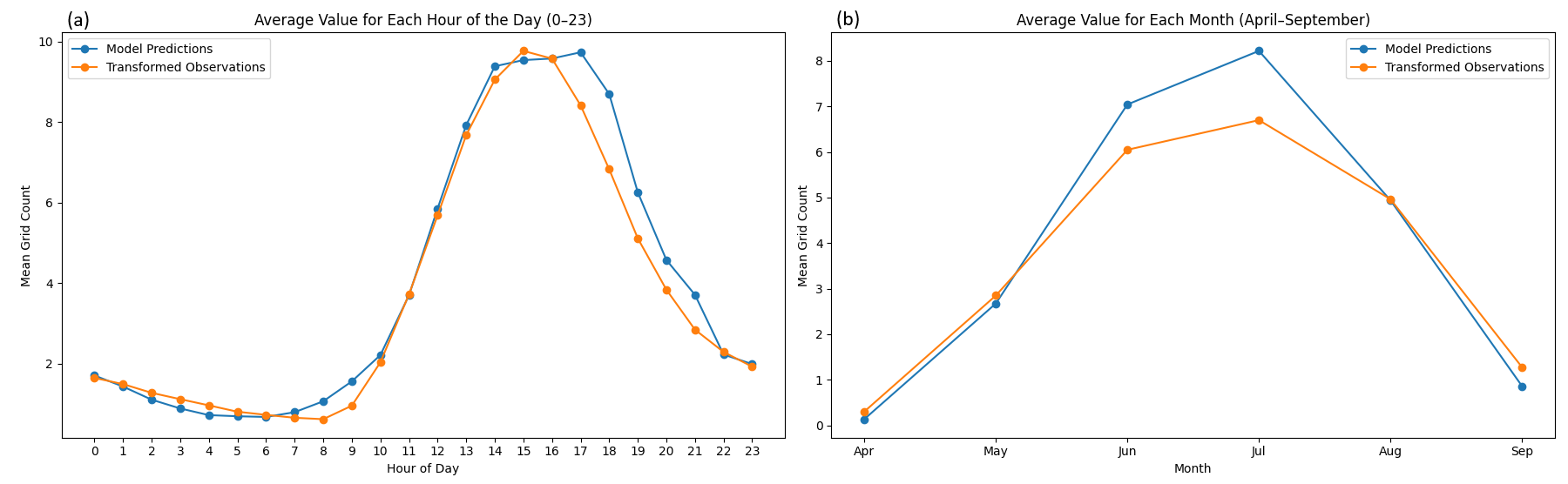
The hourly configuration of the model predictions allows a comparison of the temporal development of the model results with observed PHTs (Fig. 3). Although the modeled maximum is 2 hours delayed (Fig. 3a), the model still captures the diurnal cycle of PHTs reasonably well. This is encouraging, as the model prediction is based only on convection-relevant parameters with low horizontal resolution and does not include any parameters that take convection-relevant trigger mechanisms into account. The model also exhibits a seasonal cycle comparable to the observed PHTs (Fig. 3b), but overestimates their occurrence, especially in June and July.
Current efforts are focused on improving the model by adding input parameters or modifying the model architecture. The next step is to apply the developed ML model to convective parameters derived from climate models, to obtain an estimate of the future development of PHTs. This approach bridges the gap between observed climatology and future hazard.
References:
B. Czernecki, M. Taszarek, P. Szuster. thundeR: Computation and Visualisation of Atmospheric Convective Parameters. R package version 1.1.5 (2025), https://bczernecki.github.io/thundeR/
H. Hersbach, B. Bell, P. Berrisford, S. Hirahara, A. Horányi, J. Muñoz-Sabater, J. Nicolas, C. Peubey, R. Radu, D. Schepers, et al., The ERA5 global reanalysis, Q. J. R. Meteorol. Soc. 146 (2020) 1999–2049, doi:10.1002/qj.3803.
M. Kunz, U. Blahak, J. Handwerker, M. Schmidberger, J. Punge, H. S. Mohr, E. Fluck, M. Bedka, K. The severe hailstorm in Germany on 28 July 2013: Characteristics, impacts, and meteorological conditions, Q. J. R. Meteorol. Soc. 144 (2018) 231–250. doi:10.1002/qj.3197
S. Mohr, M. Tonn, M. Augenstein, C. Sperka, G. Kavil Kambrath, M. Kunz. A 20-year spatio-temporal analysis of 3D radar-based hail tracks in Germany: trends and regional differences, Front. Environ. Sci. 14 (2026) 1736782. doi:10.3389/fenvs.2026.1736782.