
Radiosonde and Dropsonde Observations during NAWDIC
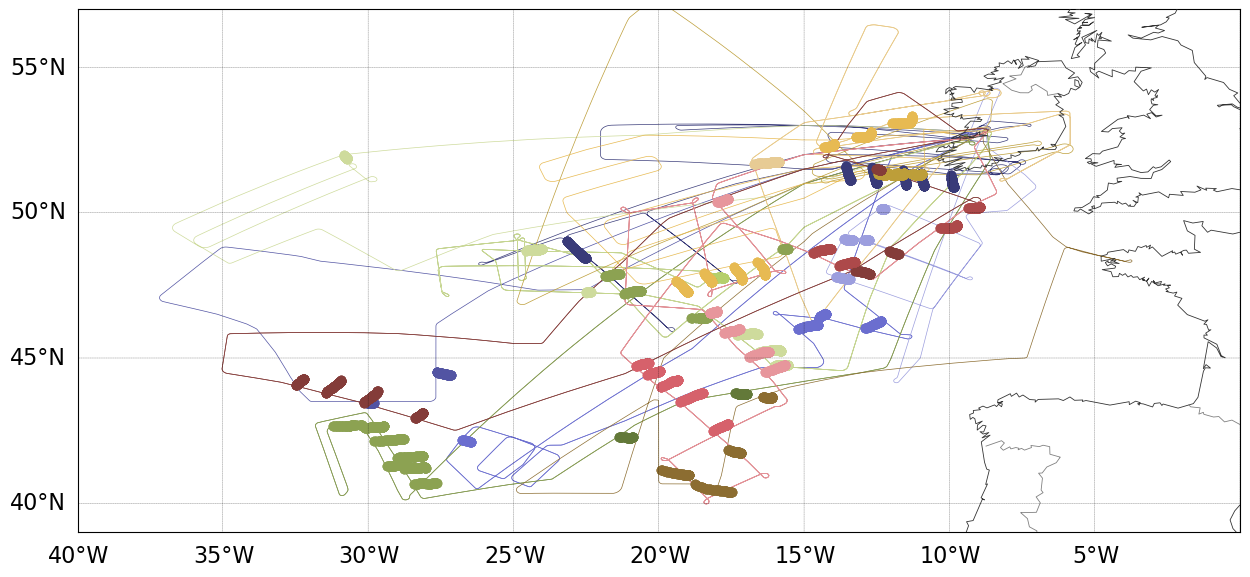
During the winter months, extratropical cyclones often develop over the North Atlantic and frequently affect Western and Central Europe. These systems are commonly associated with strong winds, heavy precipitation, and cold-air outbreaks, which can lead to high-impact weather situations, causing widespread socioeconomic damage. To improve our understanding of the dynamical and physical processes that lead to high-impact winter weather, and ultimately to improve forecasts of such events, the North Atlantic Waveguide, Dry Intrusion, and Downstream Impact Campaign (NAWDIC) was conducted (https://www.nawdic.kit.edu/). This large-scale measurement campaign took place in winter 2026 and collected observations from aircraft and ground-based instruments. The campaign focused on regions where indications of systematic deficiencies in weather forecasting models exist. For this purpose, three European research aircraft, including the „High Altitude and Long Range Research Aircraft“ HALO (https://www.dlr.de/de/forschung-und-transfer/projekte-und-missionen/halo), were deployed from Ireland. During 18 research flights at altitudes ranging from 4 to 14 km, HALO measurements covered large parts of the North Atlantic (Fig. 1). In addition to the airborne component, groundbased measurements were conducted at the Western European coast of France with the KITcube, KIT’s mobile atmospheric measurement platform.
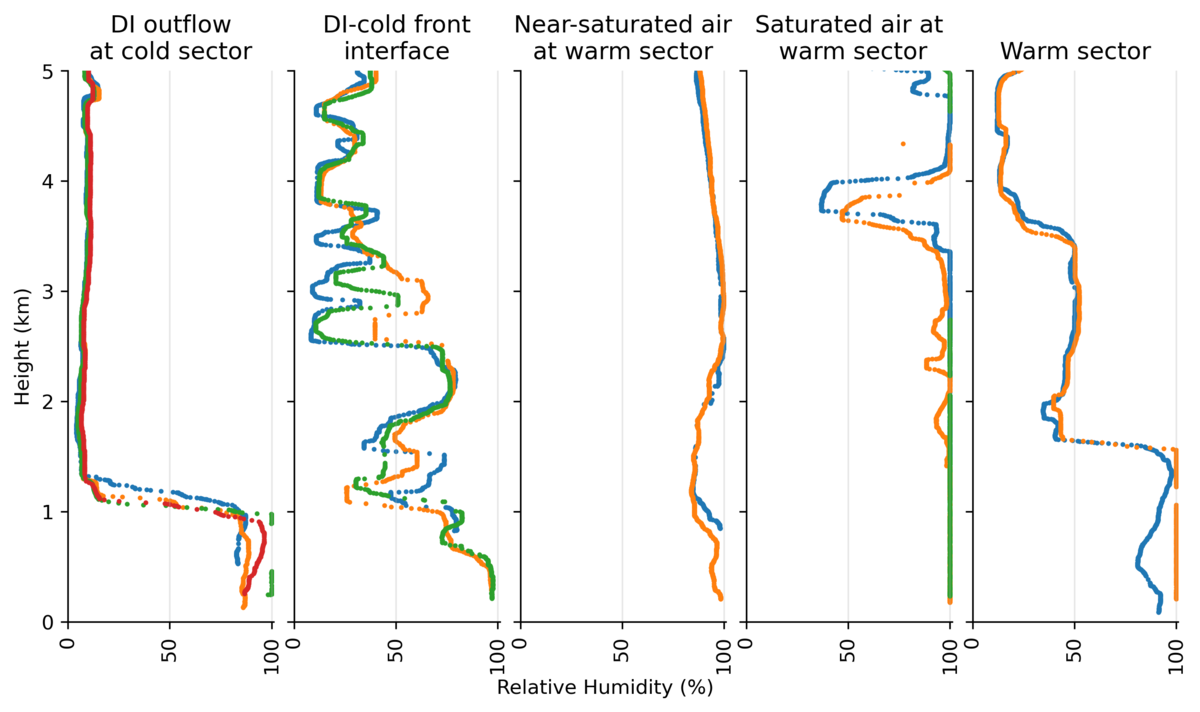
A central focus of the campaign was the investigation of the so-called dry intrusion (DI), a coherent airstream that descends equatorward from the flank of upper-tropospheric ridges into the cold sector of downstream extratropical cyclones . The DI outflow in the lower troposphere is very dry and is often associated with high-impact weather conditions, such as strong wind gusts. As the DI descends, it can interact with the cold front of an extratropical cyclone. However, the details of how the DI interacts with the cold front, and how this interaction modifies frontal characteristics and associated precipitation, remain not fully understood. In contrast to the dry descending air of the DI, which often produces a sharp humidity gradient at the top of the boundary layer, the cold front is associated with moist and nearly saturated air. Vertical profile measurements of humidity, temperature, and wind are particularly valuable for better characterizing these features and their interaction.
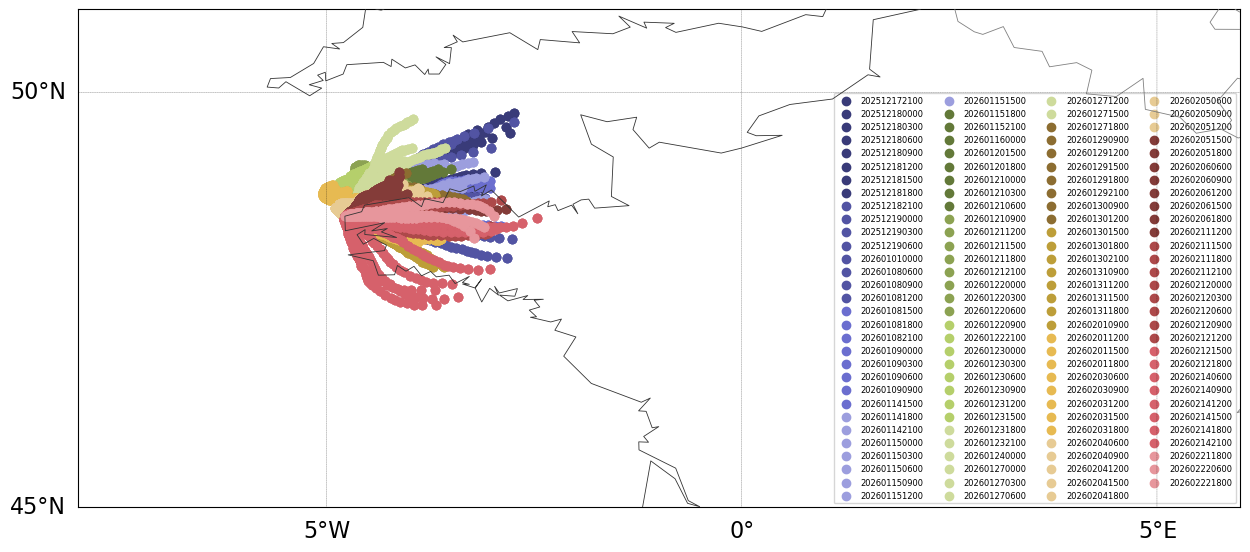
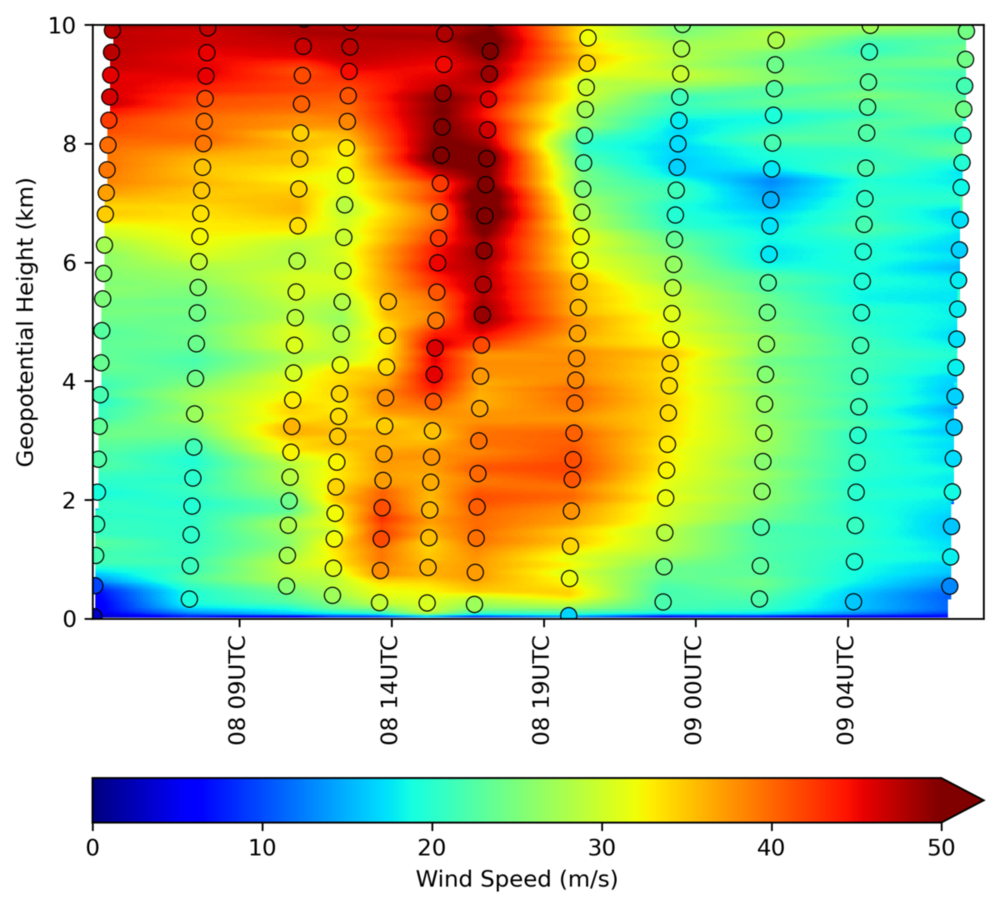
Such observations can be obtained using ground-based weather balloons, so-called radiosondes. During intensive observation periods (IOPs) of NAWDIC, radiosondes were launched from the KITcube site every three hours to capture the thermodynamic evolution during the passage of a cold front and subsequent cold sector and DI over the measurement site. As the balloons ascend, they drift with the ambient wind, providing measurements along their trajectories (Fig. 2). The distribution of radiosonde drift reflects the prevailing southwesterly to northwesterly flow typical of high-impact winter weather (Fig. 2). The example of an IOP in January (Fig. 3) shows very high wind speeds measured in the boundary layer, which are associated with the passage of a cold front.
A limitation of ground-based observations is their fixed launch location. To overcome this limitation, dropsondes can be released from research aircraft to target specific weather situations. During NAWDIC, a novel multi-sensor dropsonde system, the KITsonde (Kottmeier et al., 2025; https://www.imk-tro.kit.edu/english/12866.php), was deployed from the HALO research aircraft. The KITsonde system can release up to four individual sondes simultaneously, each equipped with parachutes of different sizes. As a result, the sondes drift apart during their descent, allowing additional measurements of mesoscale variability.
One example of targeted cold front observations was a research flight at the end of February, called Killaloe. During this flight, a curtain of dropsondes across the DI outflow, cold front, and warm sector provides detailed mesoscale measurements (Fig. 4). The DI is characterized by very dry air and forms a sharp gradient at the top of the boundary layer, while air masses in the frontal region and warm sector are near-saturated up to larger altitudes. At the interface between the descending DI and the cold front, air masses of different characteristics mix, leading to small-scale variability and vertical layering in the moisture profile.
The insitu profile measurements are used not only for detailed process studies, but also play a crucial role in weather forecasting by providing essential observations for data assimilation (e.g., Laroche and Sarrazin, 2013). Operationally, radiosonde data are distributed to meteorological services via the Global Telecommunication System (GTS), enabling their use in operational forecasting. For NAWDIC, a dedicated data-processing workflow was established to transmit dropsonde observations from the campaign to the GTS in near-real time with support from the German Weather Service (DWD). Both radiosonde and dropsonde observations were successfully assimilated and used for operational forecasts by several forecasting centres, including DWD and the European Centre for Medium-Range Weather Forecasts (ECMWF). Figures 1 and 2 illustrate all dedicated NAWDIC observations that DWD assimilated. While the ground-based radiosondes provided high-temporal-resolution observations at the KITcube site, the dropsondes deployed from the HALO aircraft covered large parts of the North Atlantic, enabling observations in otherwise data-sparse regions. Future analyses will assess how these additional campaign observations influenced forecasting systems through their assimilation.
References
Kottmeier, C., Wieser, A., Corsmeier, U., Kalthoff, N., Gasch, P., Kirsch, B., Ebert, D., Ulanowski, Z., Schell, D., Franke, H., Schmidmer, F., Frielingsdorf, J., Feuerle, T., and Hankers, R.: A new versatile dropsonde for atmospheric soundings – the KITsonde, Atmos. Meas. Tech., 18, 3161–3178, https://doi.org/10.5194/amt-18-3161-2025, 2025.
Laroche, S., and Sarrazin, R.: Impact of Radiosonde Balloon Drift on Numerical Weather Prediction and Verification. Wea. Forecasting, 28, 772-782, https://doi.org/10.1175/WAF-D-12-00114.1, 2013.