
Kronenplatz as a real-world laboratory for climate-adapted urban development
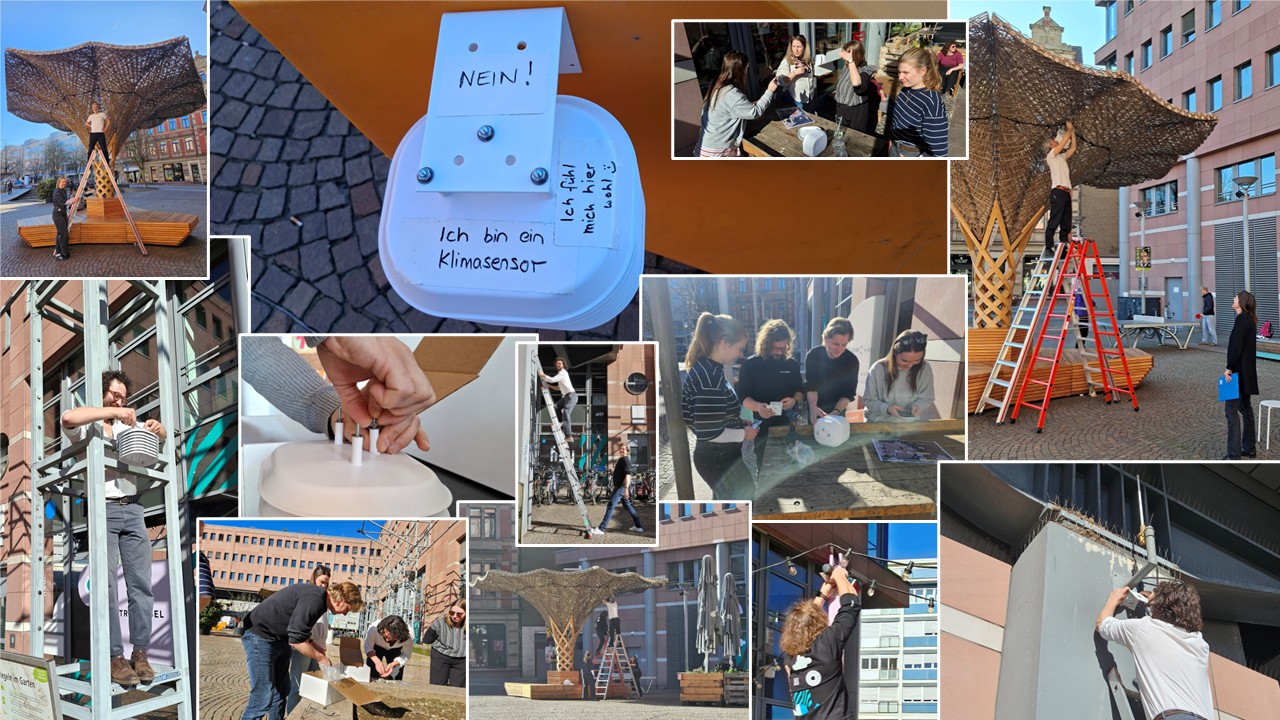
Rising temperatures, increasing densification and a wide range of competing uses are fundamentally changing the requirements for public spaces. Inner-city squares in particular are often highly stressed on hot days and lose their quality as places to stay and spend time. Kronenplatz in Karlsruhe’s city center is a striking example. As one of the warmest locations in the city, it is the focus of an interdisciplinary research project that is gradually transforming it into a real-world laboratory for climate-adapted urban design.
The aim of the “Kronenplatz Effect” project is to directly link scientific analysis, spatial design and societal dialogue. Instead of relying solely on theoretical models, measures are tested directly in the urban space and their effects are systematically examined. The project therefore follows an approach in which civil society, public administration and academia work closely together from the outset.
A key foundation of the project is the continuous climatic monitoring at Kronenplatz. Sensors installed at several locations record data on temperature and humidity, making the square’s microclimate visible in detail. These fine-scale measurements make it possible to analyze differences within the site and to better assess the impact of individual changes. Kronenplatz thus functions as a permanent test field for generating robust findings on climate-adapted design of public spaces.
Alongside the scientific investigations, design interventions already exist at the square that help raise awareness of urban heat. One example is the mobile shading structure “komorebi,” which was developed independently of the current research project but is now perceived as a defining element of the site. Such interventions demonstrate how strongly shading measures can influence the use and perception of an urban space and provide valuable impulses for the ongoing research.
In June, the project will be expanded through the planned integration of the spatial installation CORNER. CORNER is conceived as a flexibly usable place for exchange, knowledge transfer and encounter, enabling events, workshops and discussions to take place directly at Kronenplatz. In this way, social aspects are increasingly brought into focus alongside climatic effects, including questions of use, appropriation and social interaction in public space.
The project is supported by an inter- and transdisciplinary consortium from architecture (fbta), regional sciences (IfR), climate research (IMKTRO) and Department IV at KIT. Funding is provided by the Schleicher Foundation. The close exchange with the City of Karlsruhe is particularly noteworthy. The Office for Environmental and Occupational Safety and the City Planning Office actively accompany the project and contribute their professional expertise and practical perspectives from the very beginning. This constructive collaboration ensures that the insights gained are not only scientifically relevant but can also be incorporated into future planning and decision-making processes.
The so-called “Kronenplatz Effect” exemplifies a new way of addressing the urban challenges of climate change. Through the systematic combination of measurement data, design and societal dialogue, insights emerge that extend beyond Kronenplatz and can serve as a reference for other municipalities seeking climate-resilient and livable urban development.